other things: cardiff book talk – 19 Nov 2018

ursula

Ursula Le Guin’s A Wizard of Earthsea.

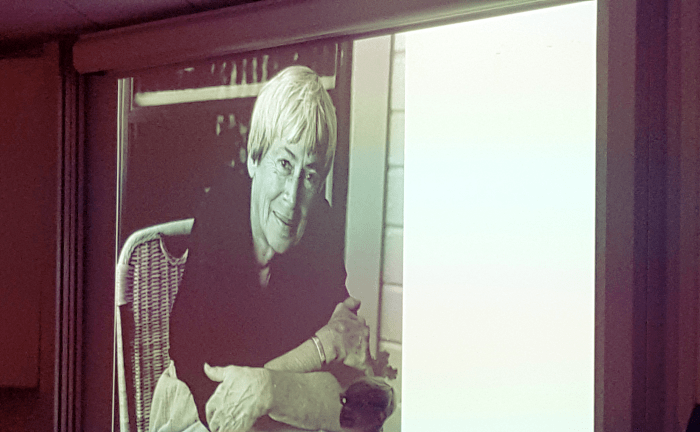
This Cardiff Book Talk event, marking Ursula Le Guins death earlier this year, and 50 years since The Wizard of Earthsea was published, felt like a direct result of Facebooks insidious targeted marketing, but I’m ok with it. You can find out about Cardiff Book Talk here in a much more direct and concise way than me rambling on about it, so check them out. Especially if you’re local to Cardiff.

I’m not going to go through everything that was discussed in too much depth, or ‘review’ the event in any way so I’m not sure what this is really. But I will share some comments from the speakers and myself, as well as some suggested further reading (in bold) if you’re also a Le Guin fan or think you might be interested in her work. That ok? Yep? Great.

So for starters if you haven’t read the Earthsea Cycle, a set of four absolutely wonderful books, then go forth and do that. The four books include; The Wizard of Earthsea, The Tombs of Atuan, The Farthest Shore and Tehanu. As you will read below, the Earthsea world is often compared to Tolkein’s Middle-earth, but differs in some really interesting ways, which were discussed in the talk.

There were three speakers at the event, each looking at the book, and the author from slightly different angles.

Dr Dimitra Fimi, from the University of Glasgow, really delved into the differences between Le Guin and Tolkein as writers and the differences in the world that they create. The difference that is striking once you consider it, but I genuinely hadn’t considered it before, was that there is no villain. The quest of the book is an inner journey, and the main character, Ged, is striving to find balance in himself and in the world.

Ishi in Two Worlds by Theodora Kroeber

The Language of the Night: Essays on Fantasy and Science Fiction by Ursula Le Guin

Dr Liesl King, from the University of York St John, explored Taoism and Lao Tzu on Le Guins writings. She suggested that the Taoist principles of equilibrium and yin and yang can be seen in many of Le Guin’s writings. It was really nice to feel vindicated with the principles of minimalism; do less, use less, move more slowly <pointed look from the adult-boyfriend life-partner at this point> and interesting that I was introduced to this early in life through Le Guins writing, without really realising it.

A Book About the Way and the Power of the Way by Ursula Le Guin

Dr Catherine Butler, from Cardiff University, looked at the final book in the quartet, Tehanu, and its feminist leanings. This, I found particularly interesting, as the final book had always felt different to me, with a very different tone, but I could never pinpoint why. It was great to learn more at this event about Le Guins history and her own thoughts on her work. She wanted to use Tehanu to show audiences that she had grown as a writer and as a feminist.

The Female Hero in American and British Literature by Carol Pearson and Katherine Pope

The Other Wind by Ursula Le Guin

I’m not gonna lie, I felt a little out of place, being in a University building, with three academic speakers, feedback that I did share with the organisers. But I also appreciate that it is a Cardiff University initiative so is bound to have an academic slant and it was the depth of understanding that the speakers had that made it so compelling for me. I will definitely go along to another event, and whole-heartedly support these events happening in Cardiff. A great way to start the week, and a legitimate excuse to pop into Noodlebox.

Kelly
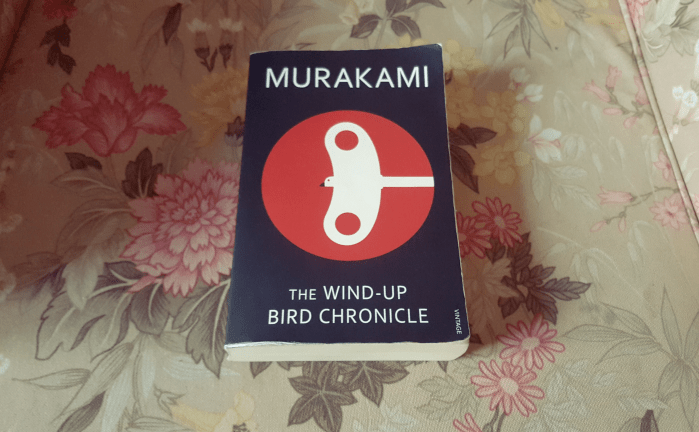
Review-ish: The Wind-Up Bird Chronicle by Haruki Murakami

windup.png

Translated by Jay Rubin.

“Spend your money on the things money can buy. Spend your time on the things money can’t buy.”

There are soooooo many quotes that I could pull from this book, so many nuggets of wisdom and joy. This quote doesn’t do it justice but it was short and I thought readers might appreciate a short quote!

I have no idea where to start with this book. I feel like I come away from Murakami’s novels never truly feeling like I have full understood the narrative (its probably because I’m skim reading!) but I sure have enjoyed the journey. I am always gripped, fully absorbed in his bonkers worlds that are vivid and all-consuming. I get peoples struggles, I really do. You’ve got to be in the right frame of mind to let go of any pre-conceptions and dive head-first into it. And sometimes, that is just not what you want.

But there’s so much in this book to get your teeth into. Mystery, history, fantasy and distinct and in-depth character development. I learnt about the Manchurian war, which I knew absolutely nothing about before, whilst also being taken along on a study of a marriage. There are such a huge range of characters that it can be easy to lose track a little bit, but as you start to get lost, Murakami will bring you back with a letter or story.

I love that Toru is an Everyman. He’s unassuming. He likes things to be neat. He’s in his 30’s and a bit lost. It’s our ability to relate to him that makes him so compelling. He’s such an accidental hero.

I’m always a little bit cautious to recommend Murakami to others. They’re usually massive for a start, and his style definitely isn’t for everyone. I would say not to start with Norweigan Wood, as now I can see that it isn’t reflective of his work (Sorry, adult live-in boyfriend, I let ya down there). The three I have read most recently though, Kafka on the Shore, The Hard-Boiled Egg and the End of the World and this gem are much more similar in style. For someone with a limited visual imagination, Murakami is a dream. Genuinely, it is books like this that make me love to read; the sort of books that make you cancel social engagements and go to bed early to enjoy.

Many Goodreads peeps have suggested multiple readings so I definitely think I would come back and give it another go at some point. With re-reading, I wouldn’t rush through it in excitement and might take a bit more of the actual plot in.  I’ll have another crack at Kafka on the Shore as well.


Anyone else fan? Any other Murakami recommendations?

Kelly

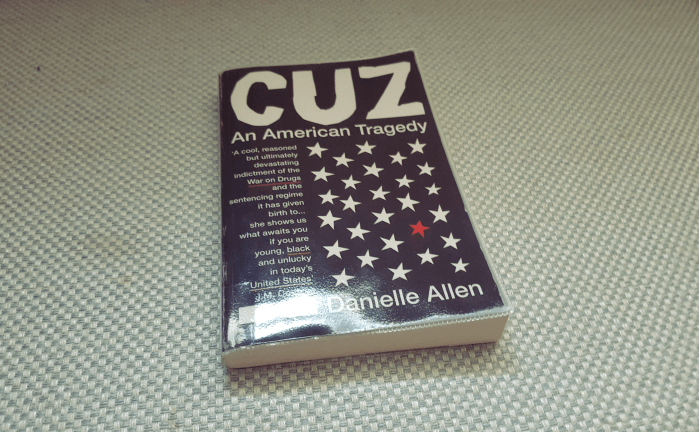
Review-ish: Cuz by Danielle Allen

cuz

An American Tragedy.

‘Deterrence dehumanizes. It directs at the individual the full hate that society understandably bears toward an aggregate phenomenon.’

This book was another library-lure, when I had no intention of picking up anymore books. The local-to-work library has a ‘new books’ display that seems to get me every time. Although a small book, I can’t say it was a quick read.

I thought that the most powerful parts of this book were when the author was talking about the statistics of the prison system in America, and the sections where she talks about how crime grew in American and its impact on minority communities. These were informative and powerful and were the things that I think drew most people to the book.

But I did struggle with much of the rest of the book. There were glimmers of lovely prose and I absolutely felt the guilt and sadness that she felt about her impact (or lack thereof) on her cousins life. Sometimes it felt a bit ungainly which meant that what should have been powerfully emotional, felt clunky.

I would be really interested to read more around the subject of race in America so please send me recommendations.

Kelly


Insole Court Book Club – October

Americanah by Chimamanda Ngozi Adichie

I was so delighted to run the very first Insole Court Book Club meeting on Tuesday and grateful to all of those who braved the cold and dark to join us for a chat. We discussed Americanah by Chimamanda Ngozi Adichie, our first book club book, which stimulated a lot of interesting discussions. As promised, I wanted to share some of the comments, thoughts and further reading/viewing that was suggested by the group.

Noting the star-crossed lovers…I didn’t care.

They’re not always right (In reference to the other characters).

Scene where Ifemelu gets her hair done, very entertaining and engaging.

How class plays out in it is very interesting.

The conversation around depression and mental health, something that isn’t acknowledged in Nigeria.

(In reference to Obinzi) he was a bit golder than gold. Too perfect.

Oh shit, I’m not Kimberley am I?

The grass is always greener.

Its a privilege to hear a female writer talk about these issues.

The book will date due to Trump’s America.

  • Roots by Alex Haley
  • Why I’m No Longer Talking to White People About Race by Reni Eddo-Lodge
  • Hamilton the Musical
  • Black Earth Rising on BBC
  • The Dock of the Bay on ITV


Please feel free to comment below and continue the discussion!

Our next book club book is Everything I Never Told You by Celeste Ng, and the meeting is on Tuesday 27th November, 7 – 9pm.

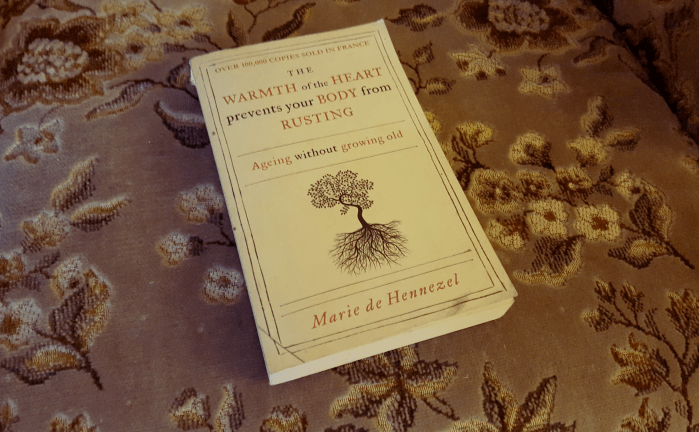
Review-ish: The Warmth of the Heart prevents your Body from Rusting by Marie de Hennezel

warmth

Ageing with growing old. Translated by Sue Dyson.

‘The worst is not inevitable. Something within us does not grow old. I shall call it the heart, the capacity to love and to desire, that inextricable, incomprehensible force which keeps the human being alive…’

A little bit of non-fiction to mix things up a bit. This book was bought for me as a gift by my boss as its very much applicable to my job, so I’m aware that I have a special interest. So that’s a bit of background.

I love that someone on Goodreads described this book as ‘very French’. It is wonderfully French. Full of joie de vivre which is the point of it really. Hennezel paints beautifully vivid images of eccentric, smiling Europeans; loving life, laughing and shagging in older age.

It is chock-full of anecdotes from a range of people; academics, researchers, students, nuns, doctors, authors and people living with dementia and their friends and families, with Hennezel’s own thoughts weaving in between. This diverse ranges of voices and experiences creates a really rich tapestry of what ageing can mean for different people.

As much as I think that everyone could take something very important from this book about the way we look at ageing, I am very aware that it’s a big part of my life at the moment and therefore isn’t something that everyone wants to examine. It can be upsetting to think about ageing, but this is a light-hearted approach with a positive message; every person can change the way they think about ageing and can enjoy life until the end.

It’s absolutely the sort of non-fiction that I enjoy. There’s a very human element to it, a bit of a narrative. Its read-able but also you can pick up as and when. I read it over a series of weeks alongside any fiction I happened to be reading. I learnt a long-time ago that I can’t read two fictional books simultaneously. I only have a certain amount of imagination-RAM in my brain box.

I’m only hesitant to recommend this book to others because I know that I have a bias and have read a lot already about ageing. Has anyone else had this experience when recommending non-fiction?

Kelly

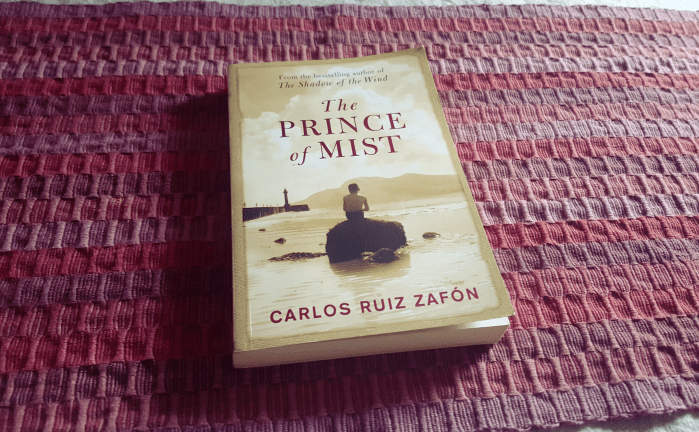
Review-ish: The Prince of the Mist by Carlos Ruis Zafón

prince

Originally published in Spain as El Príncipe de la Niebla. This version is translated by Lucia Graves.

“Whenever it poured like this, Max felt as if time was pausing. It was like a cease-fire during which you could stop whatever you were doing and just stand by a window for hours, watching the performance, an endless curtain of tears falling from heaven.”

I originally picked up this book as I loved Shadow of the Wind, which I read on whilst driving through Spain several years ago. I loved the fast-paced nature of his writing and how evocative Shadow was of Barcelona, somewhere I had never visited but now have such a clear image in my mind of.

The Prince of the Mist is Zafón’s debut novel, aimed at younger readers. Like so many of my favourite YA novels, it doesn’t shy away from darker themes. This novel, set during the second world war in an undisclosed location (to me it was reminiscent of a seaside town in my home county of Devon) it touches on the war’s looming presence for many young people. It also carefully and delicately examines the flawed nature of adults, and some of the well-intentioned mistakes they can make in trying to protect children.

The pacing of it may have distracted me from some of the less well-written bits, as many reviewers on Goodreads are suggesting that it isn’t as beautifully written as Shadow but either way, it reads well, with Zafón’s trademark poetry at its heart. According to Wikipedia, Shadow was also translated by Lucia Graves.

I’m not ashamed to say that this book gave me nightmares! The way that the ‘monster’ is described is so chilling, it really got into my psyche. But that isn’t to say that its not suitable for younger readers. I heard a Radio 4 programme this week where authors were talking about writing for children and how you can present really quite scary scenarios as long as you give the reader a glimmer of hope. This programme really got me thinking about some of my favourite YA books and the importance of them in a young readers development.

I have spent a lot of time recently looking for books for my pre-teen sisters; books that I have loved, but also books that offer something a bit different from the boy-meets-girl story-line, or in fact, the boy-saves-girl trope. Clearly all children are different and have different reading ages, as well as differing levels of maturity, but it can be so hard to find guidelines for suitability of books.

I really try to read everything that I give out as presents in advance but its not always possible. Does anyone else enjoy buying books for the young people in their lives? Any advice or recommendations? Would anyone enjoy a post about what I have enjoyed/bought in the past?

Happy reading, people!

Kelly

Review-ish: The Power by Naomi Alderman

power

‘This is the trouble with history. You can’t see what’s not there. You can look at an empty space and see that something’s missing, but there’s no way to know what it was.’

Before I start, I wanted to take a moment to note the trauma that many people would have been re-living, re-hashing, and re-imagining this week. It couldn’t be a more appropriate time to discuss this book; with everything happening with the US Supreme Court nomination and the Judiciary Committee. I just wanted to say that I believe her. That I think she is incredibly brave. And that I am angry that this week will mean that many, many people won’t come forward for fear of not being believed.

To men that are our allies, please be seen. Please make your voices heard too. Clearly, its not enough for us to speak up alone anymore.

And to the book. Well. This was exciting. Totally the sort of book that you could read in one-sitting. The sort of book distracts you to the point of leaving your tea to go cold or neglect your children (should you have them). This is the perfect book for a rainy Sunday when you have nothing else to do but get fully engrossed in a book.  I finished it 1 hour into a 4 hour train journey. Annoying. Lesson learnt.

I think that there’s always a danger with a book that examines the subversion of power; that they can rely too heavily on the subversion and the writing suffers, but this stands up as a well-written piece of fiction. Even though it was the perfect book to skim-read….(I cannot break this habit, please tell me how I can be better at this!) so I had to go back through it a bit to remind myself of what I enjoyed about the writing.

The descriptions that each character give of their physical experience with the power were so wonderfully written and all distinct. Each of the four main characters that Alderman focuses on have depth and are well-constructed; saying that, I felt like I could have spent more time with all of them. I so wanted more. Which is a ringing endorsement for the thrilling ride that the book takes you on.

I really loved the introduction chapter and its interrogation of what power is, and its comparison to a tree. It’s powerful (obvs) and gripping and introduces some of the main metaphors used throughout the book.

I’m truly surprised that a book with so much press attention (here’s a Guardian review) written two years ago hasn’t been picked up for a film (that I know of). Its length and intensity mean it is crying out for a film adaptation. I have no doubt that like so many film adaptations it will be terrible…but its such a visually stimulating story. The Washington Post called it ‘our era’s Handmaids Tale’  which is not an unfair description.  In fact, I think that the writing style is actually quite similar. I found myself wandering, if like Handmaids Tale, the things that happen to the men in Atwoods novel are similar to things that have truly happened to women before… but that’s a hard comparison to make within the introduction of a force like the power. This nytimes article is fab actually, and it explains that Atwood was a mentor to Alderman whilst she wrote The Power. 

I would highly recommend this book. It’s a proper page-turner that stays with you, long after you have finished it and a loved-one has pried it out of your cold hands. Go. Enjoy. And then come back and discuss gender politics with me in the comments. Lets be good to each other. 

With love this week,
Kelly


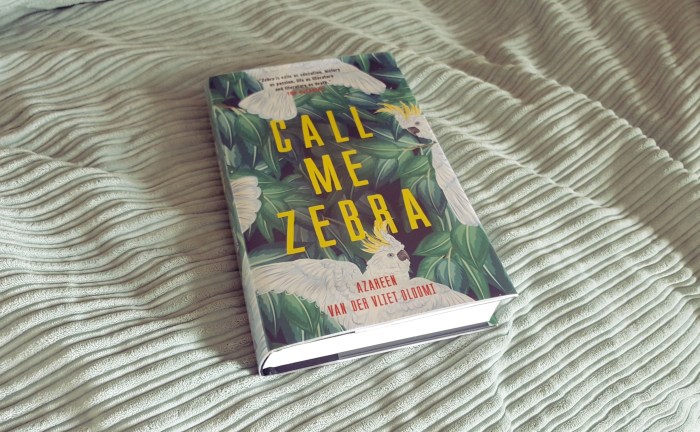
Review-ish: Call Me Zebra by Azareen Van Der Vliet Oloomi

zebra

‘My father pounded his cane against the walls of my void as he laughed. My paper heart crinkled in response. The sound of his laughter was a balm to my wounds’

I entirely judged the book by its cover on this one, Team. It was alone on a ‘featured books’ shelf at Splott Library and it’s called to me with its name and its colourful cover. I picked it up because it looked beautiful, I read it because it felt beautiful. I’m a sucker for good quality paper. I felt like I was the first person to borrow this book. It was box-fresh.

Call Me Zebra is pretty indescribable so apologies, this will just be a gushy review about how much I loved it, with very little content. The whole book speaks of an experience I know nothing about; the idea of being rootless and exiled. But its told in such a way that your lack of knowledge of this experience doesn’t matter. They way she describes the fathomlessness of loss and grief was exceptional. And I just loved the way her ancestors guided her and spoke to her. Like grown-up Lion King.

It could so easily be pretentious, with all of its literary focus but it really isn’t. I know that people have found it to be entirely pretentious, but I think you have to accept early on that you won’t know every single literary reference and just need to go with it. I haven’t read half of the books that are quoted but the human experience that she discusses are universal and easy to relate to.

I shouldn’t have looked at Goodreads as I feel fiercely protective of Zebra and love her like a slightly unhinged but kind-hearted sister. I get it, Zebra can be quite out-there but I never thought that it goes too far off the rails. I’ve definitely read books that are far more up their own arse than this one (ahem, Twilight of the Eastern Gods). I just loved Zebra’s spirit and chutzpah and all that. She’s fab and I want to be her friend, even though she’s the sort of friend that you would have to apologise for a lot, and keep away from the good wine.

I’ll shut up now because I’m so clearly biased on this one and have nothing to criticise it for. Read it. But contrary to all of my pleas for comments, please don’t tell me if you don’t like Zebra. It will hurt my feelings and I’ll never get over it.

Kelly


Review-ish: Twilight of the Eastern Gods by Ismail Kadare

easterngods

‘Artashez Pogosian, nicknamed ‘The Masses in Their Tens of Millions’ because he identified with them all at the drop of a hat, apparently delighted to have dumped his wife, swept in with the other students from the Caucasus. They were all drunk, except Shogentsukov, who had come on his own on a later train, and turned up looking slightly drained, his face exhibiting what Pogosian jokingly called his post-prime-ministerial melancholy.’

Not a favourite quote by any means. More of an example. This paragraph makes no more sense if you’ve read the book than it does on its own.

I feel so ‘meh’ about this book, I very nearly didn’t do a review. Or even finish it. But I was away for work this week and knew it would help me to sleep.

I was so up for it, based on the blurb, but it turns out that I can’t relate in any way to a young Albanian writer living in Russia in the late 50’s. He’s terribly angsty. I was also interested just because it translated from French into English from its original language (Russian/Albanian?) and I thought it would be so very worldly of me. Nah.

There’s a lot of Russian names thrown around haphazardly, but I’m sure that if I was more into it, I could have made more of an effort to follow then. But nah. Even with a genuinely interesting Introduction, written by the translator, David Bellos, it still lost me more often than not. The narrative just wasn’t engaging enough to encourage me to struggle through the Russia names, places and assumed prior knowledge.

I would recommend if you have a very specific interest in mid-century, Soviet Union authors. I mean, its not a long book, like, under 200 pages, so if you fancy it, why not give it a crack. It helped to put me to sleep regularly over the last week. Even At 4pm on a Sunday.

Kelly

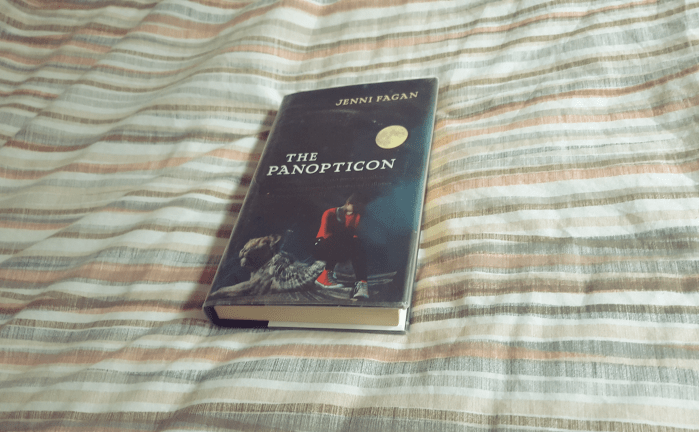
Review-ish: The Panopticon by Jenni Fagan

thepanopticon

‘Identity problem? I dinnae have an identity problem – I dinnae have an identity, just reflex reactions and a disappearing veil between this world and the next.’

To start this post, I have to say, major big up’s to Splott Library, part of Cardiff Libraries. All three books reviewed so far were picked up on a whim whilst browsing the shelves at my local-to-work library, with one eye on trying to avoid the authors I usually go for. They don’t have the largest range in the world, but I am enjoying the new-ness of it all. The message here is that even if you CAN afford to buy books new, please go out and use your local library so those who can’t access these amazing books, have the chance. Check your book-privilege.

Last night, my adult boyfriend (co-habiting life-partner, I dunno) asked me if I liked this book. I found that really hard to answer. I think part of it is because I really hate to dislike a book. I’m ok with absolutely hating something (looking at you, American Psycho), but if there’s a redeeming feature, I will find it, and there’s much about this that I liked; the hard Scottish dialect (flashbacks of Trainspotting), the message of the book, the well-developed central character. But there’s a lot I struggled with as well.

Like a few others who reviewed this book on Goodreads, I found the name of the institution The Panopticon, and the fact that Anais actually finds good friends and support systems there to be quite dissonant. Someone else mentioned that its beyond implausible that a social services institution would house children in a building designed for cruelty but I could look past that.

I always struggle with books that rely on shocking the reader to make a point. I think that there are very clever authors out there who manage to raise very important issues and/or discuss terrible subjects without needing to be explicit. I think it just felt like quite an onslaught of misery and tragedy; a microcosm of a larger, very broken system. BUT this is a very personal response. I think other readers may have a better tolerance for this than me so don’t be put off. I have to watch the Care Bears after each episode of The Wire.

All in all, it’s a good read that I smashed through very quickly (skim-reading the hard bits, again. Naughty) that you would enjoy if you like Irvine Welsh or Melvin Burgess, with the caveat that this is in no way Young Adult fiction, even if it reads like it at first. After a quick browse of her other books, I would definitely try others. Anyone have any thoughts on shock tactics in fiction? Anyone had a good sandwich today? Comments below please.

Kelly